
Most people hear the phrase data pipeline and immediately think it sounds complicated.
It sounds like something only big tech companies, cloud engineers, or senior data teams need to worry about. But the truth is simpler: every modern business that collects, stores, analyses, or uses data depends on some kind of data pipeline.
A data pipeline is not just a technical tool. It is the path that turns raw, messy information into something useful.
When you open a food delivery app and see estimated delivery time, data pipelines are involved. When an e-commerce company recommends products, data pipelines are involved. When a bank detects suspicious transactions, data pipelines are involved. When an AI system answers questions using company documents, data pipelines are involved.
Without data pipelines, businesses do not really have usable data. They only have scattered information sitting in different places.
This guide explains what a data pipeline is, how it works, why it matters, and what beginners should understand before learning data engineering seriously.
What Is a Data Pipeline?
A data pipeline is a system that moves data from one place to another, usually while cleaning, transforming, checking, and preparing it along the way.
A simple definition would be:
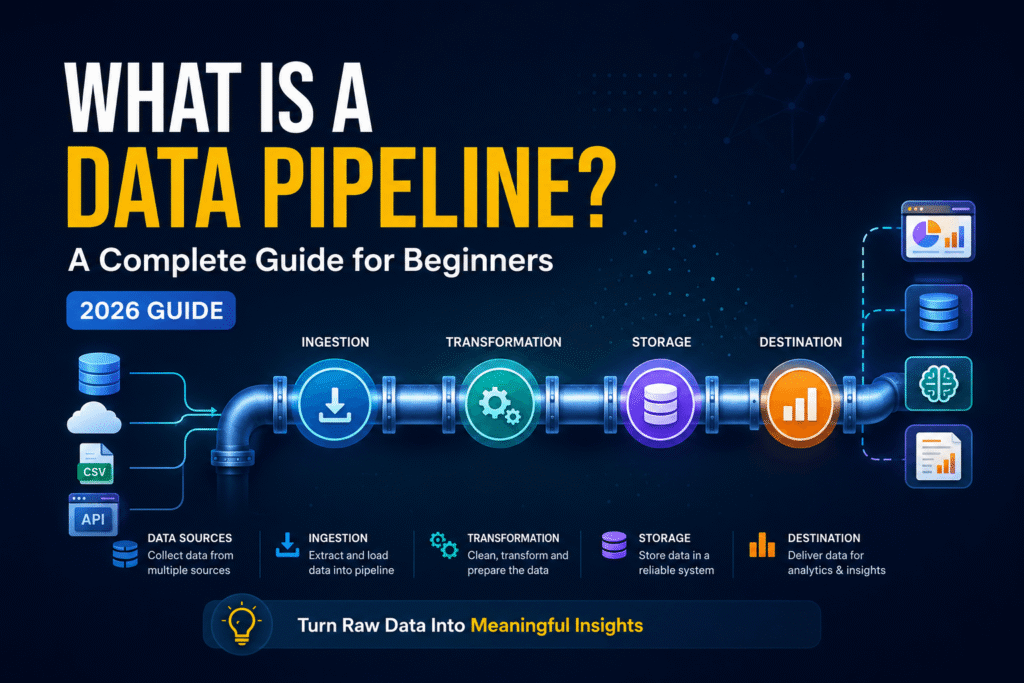
A data pipeline is a structured process that collects raw data, processes it, and delivers it to a destination where it can be used for analytics, reporting, machine learning, or business decisions.
Think of it like water moving through pipes.
Water starts from a source, passes through filters, travels through connected pipes, and finally reaches a tap where people can use it. A data pipeline works in a similar way.
Data starts from a source, moves through processing steps, gets cleaned or transformed, and finally lands somewhere useful, such as:
- a database
- a data warehouse
- a dashboard
- a machine learning model
- an analytics platform
- an AI application
The important point is this: raw data is rarely useful by itself. It usually needs to be collected, structured, cleaned, and delivered properly before it becomes valuable.
A Simple Example of a Data Pipeline
Imagine an online clothing store.
Every day, the business collects data from different places:
- customer orders
- website visits
- product views
- payment records
- delivery updates
- refund requests
- marketing ads
- customer reviews
Now imagine the company wants to answer a simple question:
Which products made the most profit last month?
That sounds easy, but the data is not sitting neatly in one place.
Order data may be in one database. Payment data may be in Stripe or Razorpay. Website data may be in Google Analytics. Product cost data may be in a spreadsheet. Refund data may be somewhere else.
A data pipeline can collect all this information, combine it, clean it, calculate profit, and send the final result into a dashboard.
Without a pipeline, someone would have to manually download files, copy data into Excel, fix errors, match columns, and create reports again and again.
That is slow, risky, and not scalable.
A data pipeline automates the process.
Why Do Businesses Need Data Pipelines?
Businesses need data pipelines because raw data is usually spread across many systems.
In the past, small businesses could survive with manual reports and spreadsheets. In 2026, that is becoming less practical. Even a medium-sized company may use dozens of tools: CRM systems, payment platforms, websites, apps, customer support tools, inventory software, marketing platforms, and cloud databases.
Each system creates data. But if the data stays separated, it cannot help the business properly.
A good data pipeline helps a business:
- Save time by automating repetitive data work.
- Reduce mistakes caused by manual copying and editing.
- Improve decisions by giving teams accurate information.
- Support AI and machine learning with clean, structured data.
- Create dashboards that update automatically.
- Monitor business performance in near real time.
- Scale operations as data volume grows.
The real value of a data pipeline is not only technical. It gives people confidence that the numbers they are looking at are correct.
That matters because wrong data leads to wrong decisions.
How Does a Data Pipeline Work?
Most data pipelines follow a basic flow.
The exact tools may change, but the logic is usually the same.
1. Data Sources
The pipeline starts with data sources.
A data source is any system where data is created or stored.
Common sources include:
- application databases
- APIs
- CSV or Excel files
- cloud storage
- websites
- mobile apps
- payment systems
- CRM tools
- IoT devices
- logs from servers
- third-party platforms
For example, an e-commerce business may collect data from Shopify, Google Analytics, Facebook Ads, Stripe, and its own internal database.
The first job of the pipeline is to connect to these sources and collect the required data.
2. Data Ingestion
Data ingestion means bringing data into the pipeline.
This can happen in different ways.
Some pipelines collect data every hour or every day. Others collect data continuously as soon as it is created.
For example:
- A daily sales report may only need data once per day.
- A fraud detection system may need data within seconds.
- A recommendation engine may need updated user behaviour frequently.
Data ingestion can be simple or complex depending on the use case.
A beginner should understand one thing clearly: ingestion is not just about copying data. It is about collecting the right data, at the right time, in a reliable way.
3. Data Storage
After data is collected, it usually needs to be stored somewhere.
This storage may be temporary or permanent.
Common storage destinations include:
- relational databases like PostgreSQL or MySQL
- data warehouses like BigQuery, Snowflake, or Redshift
- data lakes like Amazon S3
- NoSQL databases like MongoDB
- vector databases for AI applications
The choice depends on what the business wants to do with the data.
For example, if the goal is business reporting, a data warehouse may be best. If the goal is storing huge raw files, a data lake may be better. If the goal is building a RAG-based AI chatbot, a vector database may be needed.
Storage is not only about keeping data. It is about keeping data in a way that makes it useful later.
4. Data Transformation
Raw data is often messy.
It may contain missing values, duplicate records, wrong formats, inconsistent names, or useless columns.
Data transformation is the process of converting raw data into a clean and useful format.
This may include:
- removing duplicates
- fixing date formats
- converting currencies
- joining tables
- filtering unnecessary records
- renaming columns
- calculating new fields
- standardising text
- handling missing values
For example, one system may store dates as 2026-05-31, another may store them as 31/05/2026, and another may store them as text. A pipeline can standardise all of them into one format.Transformation is one of the most important parts of a data pipeline because this is where raw information becomes meaningful.
5. Data Validation and Quality Checks
A serious data pipeline does not blindly trust data.
It checks whether the data is correct.
Data quality checks may answer questions like:
- Are there missing values in important columns?
- Are there duplicate customer IDs?
- Are sales amounts negative when they should not be?
- Did today’s data arrive on time?
- Is the number of records unusually low or high?
- Are all required fields present?
This step is important because broken data can silently damage business decisions.
For example, if a dashboard shows revenue dropped by 80%, is that a real business problem or did the pipeline fail to collect half the orders?
Without validation, nobody knows.
Good data pipelines make errors visible.
6. Data Orchestration
A pipeline usually has multiple steps.
One task may need to run before another. Some tasks may run daily. Some may run hourly. Some may depend on external systems.
Orchestration means managing when and how these tasks run.
For example:
- Collect order data.
- Collect payment data.
- Clean both datasets.
- Join them together.
- Calculate revenue.
- Update the dashboard.
These steps must happen in the correct order.
Tools like Apache Airflow, Prefect, Dagster, and Luigi are often used for orchestration.
For beginners, orchestration simply means controlling the workflow so the pipeline runs properly without someone manually pressing buttons.
7. Data Destination
The final step is sending processed data to a useful destination.
This could be:
- a dashboard for business teams
- a database for an application
- a data warehouse for analysts
- a machine learning model
- an AI search system
- a report sent by email
- an API used by another system
The destination depends on the purpose of the pipeline.
A pipeline is only useful if the final output helps someone or something make better decisions.
ETL vs ELT: What Is the Difference?
When learning data pipelines, you will often hear two terms: ETL and ELT.
They look similar, but the order is different.
ETL: Extract, Transform, Load
In ETL, data is extracted from the source, transformed first, and then loaded into the destination.
The flow is:
Extract → Transform → Load
This approach was common when storage and computing power were more limited. Data had to be cleaned before entering the warehouse.
ELT: Extract, Load, Transform
In ELT, data is extracted from the source, loaded into storage first, and transformed later.
The flow is:
Extract → Load → Transform
This is common in modern cloud data systems because platforms like BigQuery, Snowflake, and Redshift can handle large-scale transformations inside the warehouse.
Which One Is Better?
Neither is always better.
ETL can be useful when data must be cleaned before storage. ELT can be better when you want to store raw data first and transform it flexibly later.
In modern data engineering, ELT is very common, especially with cloud data warehouses.
But the real question is not “Which term sounds better?” The real question is:
What does the business need, and what architecture supports it reliably?
Batch Processing vs Stream Processing
Another important concept is the difference between batch and stream processing.
Batch Processing
Batch processing handles data in groups at scheduled times.
For example:
- every night at 12 AM
- every hour
- every Monday morning
- once per day
A daily sales report is a good example of batch processing.
Batch processing is easier to build and maintain. It is useful when real-time results are not required.
Stream Processing
Stream processing handles data continuously as it arrives.
For example:
- live fraud detection
- real-time delivery tracking
- stock market alerts
- live website activity monitoring
- real-time recommendation systems
Stream processing is more complex but useful when speed matters.
A beginner should not think real-time is always better. Real-time systems are harder and more expensive. Many businesses do not need them.
The best pipeline is not the most advanced one. The best pipeline is the one that solves the actual problem.
What Makes a Good Data Pipeline?
A good data pipeline is not just one that works once.
It should work repeatedly, reliably, and clearly.
Here are the qualities of a strong data pipeline.
1. Reliability
The pipeline should run without constantly breaking.
Failures can happen, but they should be handled properly. A good pipeline has retries, alerts, logs, and error tracking.
2. Scalability
The pipeline should handle growth.
If data volume doubles next month, the system should not collapse immediately.
3. Data Quality
The pipeline should check data before people use it.
Bad data is worse than no data because it creates false confidence.
4. Maintainability
Other engineers should be able to understand and update the pipeline.
Messy scripts with no structure may work temporarily, but they become dangerous over time.
5. Observability
The team should know what is happening inside the pipeline.
If something fails, they should know where, why, and how to fix it.
6. Security
Data pipelines often handle sensitive information.
Access control, encryption, privacy rules, and compliance should not be ignored.
7. Clear Business Purpose
A pipeline should not exist just because technology is interesting.
It should support a real business goal.
Common Data Pipeline Tools
There are many tools in the data engineering ecosystem. Beginners do not need to learn all of them at once, but they should understand the categories.
Programming Languages
Python and SQL are the most important starting points.
Python is used for automation, APIs, data processing, and pipeline logic. SQL is used for querying, transforming, and analysing structured data.
Databases
Common databases include PostgreSQL, MySQL, MongoDB, and SQL Server.
A data engineer should understand how data is stored, queried, indexed, and connected.
Data Warehouses
Popular cloud data warehouses include BigQuery, Snowflake, Amazon Redshift, and Azure Synapse.
These are used for analytics and large-scale reporting.
Orchestration Tools
Tools like Apache Airflow, Prefect, Dagster, and Luigi help schedule and manage workflows.
Apache Airflow is especially common in many data engineering jobs.
Processing Tools
For large-scale data processing, tools like Apache Spark are widely used.
For real-time data, Apache Kafka is commonly used.
Data Quality Tools
Tools like Great Expectations can be used to test and validate data.
Cloud Platforms
AWS, Google Cloud, and Microsoft Azure are important because many modern pipelines run in the cloud.
A beginner does not need to master every cloud service immediately, but understanding the basics of storage, compute, databases, and permissions is useful.
A Real-World Data Pipeline Architecture
Let’s imagine a practical architecture for a small business.
The business has:
- a website
- a mobile app
- a payment system
- a customer database
- marketing campaigns
- customer support tickets
A simple data pipeline could look like this:
- Data is collected from the website, app, payment provider, and CRM.
- Python scripts or APIs ingest the data.
- Raw data is stored in cloud storage.
- Cleaned data is loaded into PostgreSQL or a data warehouse.
- SQL transformations calculate revenue, customer activity, and campaign performance.
- Data quality checks identify missing or unusual records.
- A dashboard shows sales, profit, customer growth, and refunds.
- Alerts notify the team if something breaks.
This kind of pipeline can help the business answer important questions:
- Which marketing campaign is profitable?
- Which products are selling best?
- Which customers are likely to return?
- Where are refunds increasing?
- Is revenue growing or only traffic?
The pipeline turns scattered data into business intelligence.
That is the point.
Data Pipelines and AI
In 2026, data pipelines are even more important because of AI.
Many people focus only on AI models, but AI systems are only as good as the data behind them.
If the data is outdated, incomplete, biased, duplicated, or badly structured, the AI output will also be weak.
For example, a company may want to build an internal AI assistant that answers questions using company documents.
That requires a pipeline to:
- collect documents
- clean the text
- split documents into chunks
- create embeddings
- store embeddings in a vector database
- update the system when documents change
- monitor retrieval quality
This is still a data pipeline.
Modern AI applications depend heavily on data engineering. That is why the role of data engineers is becoming more important, not less important.
AI does not remove the need for pipelines. It increases the need for better ones.
Common Mistakes Beginners Make
When beginners start learning data pipelines, they often make the same mistakes.
Mistake 1: Only Learning Tools
Tools matter, but concepts matter more.
If you understand ingestion, transformation, orchestration, quality, and storage, you can learn different tools faster.
Mistake 2: Ignoring Data Quality
A pipeline that moves bad data quickly is not a good pipeline.
Data quality checks are not optional in serious systems.
Mistake 3: Building Without a Purpose
Some people build pipelines just to use trendy tools.
A better approach is to start with a business question and design the pipeline around it.
Mistake 4: Not Handling Failure
Pipelines fail.
APIs go down. Files arrive late. Databases timeout. Columns change. Credentials expire.
A real pipeline should expect failure and handle it properly.
Mistake 5: Making Everything Too Complex
Not every project needs Kafka, Spark, Kubernetes, and a huge cloud architecture.
Sometimes a simple Python script, PostgreSQL database, and scheduled job are enough.
Good engineering is not about using the most tools. It is about choosing the right level of complexity.
Skills You Need to Build Data Pipelines
If you want to become a data engineer or AI data engineer, these are the core skills to focus on.
SQL
SQL is non-negotiable.
You need to know how to query, join, filter, aggregate, and transform data.
Python
Python is useful for automation, API calls, data cleaning, scripting, and pipeline development.
Databases
You should understand tables, schemas, indexes, primary keys, foreign keys, and query performance.
APIs
Many pipelines collect data from external systems through APIs.
Understanding REST APIs, authentication, pagination, and rate limits is important.
Cloud Storage
Modern pipelines often use services like Amazon S3, Google Cloud Storage, or Azure Blob Storage.
Orchestration
Learning tools like Apache Airflow or Prefect helps you move from simple scripts to production workflows.
Data Modelling
You should understand how to structure data so it is useful for analytics and reporting.
Monitoring
A professional pipeline needs logs, alerts, and visibility.
Business Thinking
This is underrated.
A data engineer should understand why the pipeline exists and what decision it supports.
Beginner Project Idea: Build Your First Data Pipeline
A good beginner project is better than only watching tutorials.
Here is a simple project idea:
Build a sales data pipeline using Python, PostgreSQL, and a dashboard.
The pipeline can:
- Read sales data from CSV files.
- Clean missing values and duplicates.
- Store raw data in one table.
- Transform data into reporting tables.
- Calculate total revenue, top products, and monthly sales.
- Display the results in a Streamlit dashboard.
- Schedule the pipeline to run automatically.
After that, you can improve it by adding:
- API ingestion
- Airflow orchestration
- data quality checks
- logging
- cloud deployment
- Docker
- automated tests
This kind of project shows real data engineering thinking.
It is better than a basic notebook because it demonstrates an end-to-end workflow.
Final Thoughts
A data pipeline is one of the most important foundations of modern technology.
It connects raw data to real decisions.
Every dashboard, machine learning model, AI assistant, fraud detection system, recommendation engine, and business report depends on data moving correctly from one place to another.
For beginners, the main thing is not to get overwhelmed by tools.
Start with the core idea:
A data pipeline collects data, processes it, checks it, and delivers it somewhere useful.
Once that concept is clear, the tools become easier to understand.
Python, SQL, databases, orchestration tools, cloud platforms, and data warehouses are all part of the same bigger system.
The future of AI and business intelligence will not only belong to people who can build models. It will also belong to people who can build reliable systems around data.
That is why learning data pipelines is one of the best first steps into data engineering.